


A life which combines religious perfection with the study of Wisdom has a marvelous power of arousing and lifting up the hearts of the faithful.
|
|
|
A life which combines religious perfection with the study of Wisdom has a marvelous power of arousing and lifting up the hearts of the faithful. |
     |
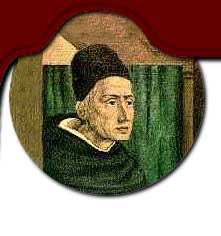
St Albert was one of the earliest generation of the Dominican order, founded in 1216; he took a large part in the momentous intellectual developments of the thirteenth century, and was declared patron of all those who devote themselves to the natural sciences, by Pope Pius XII in 1941. He is traditionally known as Albertus Magnus, Albert the Great. He was born in Swabia, within a few years of 1200 (the date is uncertain), the eldest son of a family belonging to the military nobility. He was educated at the University of Padua, already a scientific center, and joined the Dominicans as a young man. After completing his studies he taught theology; he went to Paris about 1240, and took the degree of master in sacred theology there in 1245 or 1246. For the next thirty years he led a very active life as teacher and administrator, including periods as provincial of his order in Germany and as bishop of Ratisbon, tramping the roads of Europe on long journeys. Yet his printed works, which were mostly composed in this period, fill thirty-eight quarto volumes and cover every field of learning. At Cologne and Paris he had St Thomas Aquinas as his pupil, and one of his last missions was to defend some of Thomas's writings against attacks at Paris in 1277. He died in 1280, after a pitiful period of dotage. He was canonized and declared a doctor of the church in 1931. European Christendom in the thirteenth century was by no means the secure and static civilization it is often supposed to have been. Socially, materially and intellectually it was on the march. The church was changing with the times; the foundation of the mendicant orders, Dominican and Franciscan, opened up a new kind of priestly vocation, for the friars were bound neither to a parish like the secular clergy, nor to a monastery like the monks, so that they might be free to study and preach. The friars soon found themselves in key positions in the universities, still only a few decades old, which became the chief means by which the clergy were educated. The task before the universities was immense. Up to the twelfth century, the tradition of knowledge in the Latin-speaking western world had been based mainly on the Scriptures and the commentaries of the Fathers upon them, using a philosophy that may be loosely called Platonic. At the same time, the world of Islam had assimilated the logic and philosophy of Aristotle and much of Greek science and mathematics. In the twelfth century, these scientific and philosophical works became available in Latin translations. Thus the west was confronted with a new body of knowledge, obviously valuable but alien to the Christian tradition, and accompanied by Moslem commentaries which were very acute yet clearly erroneous in part. This knowledge was all the more suspect when it was transmitted by interpreters that were at odds with Christianity. St Albert's response to the difficulties of his time combined heroic sanctity with an astonishing universality of mind. That he should throw in his lot with the new mendicant order, despite the severe temptations of family pride, was already an indication of the humility and apostolic fire for which he was conspicuous throughout his long life. But great courage and intellectual honesty as well were needed to conceive and put into practice the policy of 'baptizing' the new learning. A lesser man might have either rejected it outright, or embraced it uncritically; St Albert proposed to understand it, to make it known, and to accept whatever parts of it might be found, after critical examination, to be true. This program was begun by him and completed by St Thomas. Neither of the two was a slavish follower of Aristotle; both differed from him on important points, and St Albert wrote, 'He who believes Aristotle to have been a god ought to suppose that he never made a mistake; but if he believes him to have been a man, doubtless he could make a mistake, just as we do.' But he accepted the main lines of Aristotle's realism, and showed that Christian doctrine could be expressed in terms of it. Such a position implied a recognition of the autonomy of reason in its own sphere, in contrast with those who wished to make philosophy entirely subservient to theology; and of sense-experience as the origin of human knowledge, as against the Platonic view that it cannot give true knowledge. Both these conclusions are obviously important for natural science; indeed the changes in the intellectual climate brought about by the Aristotelean revival in the thirteenth century were probably a factor in the rapid development of science in the sixteenth. St Albert was himself a keen observer, with the interest of a true scientist in natural facts. He was not of course acquainted with scientific method and explanation as they are used today; but he had the scientific temper of mind, and in natural history he broke new ground, notably in the study of insects, as well as compiling critical encylopedic works on the whole range of natural phenomena known to him, from astronomy and mineralogy to physiology. St Albert is an especially apt patron for scientists because he made his love of truth about nature into an instrument of his love of Christ. Moreover, with all his scientific interest, he was no narrow specialist; he wrote also on logic, philosophy, theology and exegesis, with a universal and balanced outlook. Science itself is no danger to the Faith, but if a man becomes obsessed with the scientific mode of reasoning he may become blind to the truths of faith. St Albert's life shows how to meet this danger. If he appealed to observation in science, he knew that in theology he must take as his basis the doctrines of the church; if he was critical of the inaccurate observations of others, he was submissive to the teaching authority of Christ; if he was active in body and mind, he was eagerly passive to divine grace. Balance, universality and integrity might be his testament to scientists. Scholar and administrator; naturalist, philosopher and theologian; an innovator, yet a conserver of sacred doctrine; a man with an eye for detail, but always pursuing the integration of knowledge-St Albert is a mirror of the qualities that modern scientists need.
Order The Complete Works Of Albertus Magnus Now...Send Check or Money Order payable to Albert Pinto (or, if sponsoring scholars or seminarians, pay to Opus Doctorum Foundation): Address: Opus Doctorum Foundation Any questions? E-mail me: [email protected] (Or call: (610) 626 - 6938) Albert The Great Page partly sponsored by EMS:(800) 488-3158 |